
What is retatrutide?
Retatrutide (development code LY3437943, also called Reta or Triple G) is an investigational single-molecule peptide studied for its ability to activate three metabolic receptors at once: the glucagon-like peptide-1 (GLP-1) receptor, the glucose-dependent insulinotropic polypeptide (GIP) receptor, and the glucagon receptor. Developed by Eli Lilly, it belongs to the incretin class and is one of the most studied triple-hormone-receptor agonists to date, which is exactly why retatrutide research is attracting so much attention. In this guide it is discussed strictly as a research compound. Retatrutide is not approved by the TGA or any regulator, and NovaPeptides supplies it for laboratory research use only. What we can offer with confidence is transparency: an Australian-owned supplier with over 3 years serving researchers here, and a verifiable Certificate of Analysis on every batch.
Every reference to retatrutide's effects below is drawn from published preclinical and clinical research. Nothing here is medical advice, dosing guidance, or a claim of safety or effectiveness for human use. Retatrutide is supplied for research use only.
The triple agonist mechanism explained
What sets retatrutide apart in the literature is the number of receptors it engages. Semaglutide is a single agonist (GLP-1 only). Tirzepatide is a dual agonist (GLP-1 plus GIP). Retatrutide is a triple agonist, adding glucagon-receptor activation on top of both incretin pathways. This GLP-1 GIP glucagon design means each arm is investigated for a distinct contribution to metabolic signalling in research models, and it is the core reason retatrutide is such a talked-about investigational metabolic peptide.
The three receptor arms
- GLP-1 receptor: researched for its role in appetite signalling, satiety and glucose-dependent insulin secretion, the same pathway semaglutide targets.
- GIP receptor: the second incretin pathway added by tirzepatide, investigated for effects on energy balance and adipose-tissue signalling.
- Glucagon receptor: the third arm unique to retatrutide, studied for its potential influence on energy expenditure and hepatic fat metabolism in research models, a mechanism dual agonists do not engage.
The research hypothesis behind combining all three is that glucagon-receptor agonism may raise energy expenditure while the GLP-1 and GIP arms reduce energy intake, a combination investigated for whether it produces larger metabolic effects than single or dual agonists in the studied models. This triple mechanism is why retatrutide is nicknamed Triple G in the research community, and why it sits at the leading edge of metabolic peptide research.
The published research: NEJM phase 2 and the TRIUMPH program
One reason researchers feel on solid ground with retatrutide is that it is supported by peer-reviewed clinical research, which is relatively unusual for a compound at this stage of investigation. The two pillars of retatrutide research are the phase-2 obesity trial and the ongoing phase-3 TRIUMPH program.
The phase-2 trial was published in the New England Journal of Medicine (NEJM) in 2023. It was a randomised, double-blind, placebo-controlled study in adults with obesity that evaluated escalating doses over a 48-week treatment period. According to the published trial, the highest 12 mg dose was associated with a mean body-weight reduction of up to approximately 24% at 48 weeks, with the effect reported as dose-dependent across the study arms. The most commonly reported adverse events were gastrointestinal and were described in the trial as generally mild to moderate and dose-related. These are reported research findings, not claims about what the compound does in any individual.
Building on that, Eli Lilly initiated the phase-3 TRIUMPH program, a multi-trial clinical program investigating retatrutide across a range of doses and endpoints, including obesity and related conditions. TRIUMPH represents the pivotal-stage research that any future regulatory submission would draw upon, and it is a large part of why interest in retatrutide Australia wide keeps building.
Retatrutide is reported in the literature as the first triple GLP-1 GIP glucagon receptor agonist to reach large-scale phase-3 clinical investigation, and the up-to-24% figure from its phase-2 trial is among the higher weight reductions reported for an investigational molecule in the incretin class.
Retatrutide vs tirzepatide vs semaglutide
The clearest way to place retatrutide is against the two better-known incretin peptides. The defining difference is the receptor count: one, two, or three. The table below summarises how the three compounds compare on mechanism and research stage. Any figures shown are the headline numbers attributed to each compound's own published research and are not comparative or effectiveness claims.
| Attribute | Retatrutide | Tirzepatide | Semaglutide |
|---|---|---|---|
| Also known as | LY3437943, Reta, Triple G | LY3298176, Mounjaro, Zepbound | Ozempic, Wegovy |
| Receptors targeted | GLP-1, GIP and glucagon | GLP-1 and GIP | GLP-1 only |
| Agonist type | Triple agonist | Dual agonist | Single agonist |
| Developer | Eli Lilly | Eli Lilly | Novo Nordisk |
| Glucagon arm | Yes (unique) | No | No |
| Research stage | Phase 3 (TRIUMPH), investigational | Approved in some markets | Approved in some markets |
| Headline research figure | Up to approximately 24% body-weight reduction reported at 48 weeks (phase-2 trial, 12 mg) | Reported in its own published trials | Reported in its own published trials |
| TGA status | Not approved | Varies by product | Varies by product |
In short: semaglutide pioneered single-receptor incretin research, tirzepatide added the GIP arm as a dual agonist, and retatrutide adds the glucagon arm as a triple agonist. Retatrutide is the only one of the three still fully investigational, with no regulatory approval anywhere, which is precisely why the research-use-only framing and a verifiable COA matter so much when you source it.
TGA status and legal position in Australia
Here is the honest, straightforward position. Retatrutide is not approved by the Therapeutic Goods Administration (TGA). It is an investigational compound that remains in phase-3 clinical trials, and no regulator worldwide has granted it marketing approval. There is no approved retatrutide product available for prescription or supply for human use in Australia. We would rather you have that clarity up front than any vague reassurance. Where we can give you genuine confidence is in how the material is supplied. NovaPeptides is Australian-owned and has served researchers here for over 3 years, with same-day dispatch from the Gold Coast and discreet tracked shipping Australia wide. Every batch is independently lab-tested by Novagen Laboratories and carries a Certificate of Analysis you can verify yourself. That transparency is the reassurance we can honestly offer.
What this means in practice
- Retatrutide cannot be lawfully supplied, advertised, or sold for human therapeutic use in Australia.
- NovaPeptides supplies retatrutide strictly as a research reference material for laboratory use only.
- It is not a medicine, not a supplement, and is not intended for human consumption or self-administration.
- The TGA has publicly cautioned about unapproved peptides that have not been evaluated for safety, quality or effectiveness, which is exactly why buying from a transparent, Australian-owned supplier with a verifiable COA on every batch matters.
Nothing on this page should be read as encouragement to use retatrutide in humans. It is provided so researchers can understand the compound, its mechanism, and the published literature. Retatrutide is for research use only.
How to buy retatrutide Australia wide from NovaPeptides
NovaPeptides supplies retatrutide as complete research kits rather than loose vials, so researchers get a documented, verifiable unit every time. Each kit is designated by strength: RT10, RT20 and RT30, corresponding to the total peptide content of the kit. Every kit ships with a reusable dosing pen so researchers can measure reconstituted material accurately in a laboratory setting. When you buy retatrutide Australia wide from NovaPeptides, it is dispatched same-day from the Gold Coast with discreet tracked shipping.
What is in a retatrutide research kit
- The retatrutide reference compound at the labelled strength (RT10, RT20 or RT30).
- A reusable dosing pen for precise volumetric research measurement.
- A batch-specific Novagen Laboratories Certificate of Analysis (retatrutide COA).
- A unique verification key printed with the batch that you can check yourself.
Every batch is independently lab-tested and carries a Novagen Laboratories retatrutide COA documenting identity and purity for that specific lot. The COA has a unique key you can enter at novagenlaboratories.com to confirm the result is genuine and matches your kit. This third-party verification is what separates a documented research reference material from an unverified product, and it is a standard we have held for the whole of our over 3 years supplying research peptides Australia wide.
NovaPeptides operates as a catalogue and education resource. There is no online cart or public pricing. To enquire about retatrutide research kits and COA verification, message the NovaPeptides team on WhatsApp and a real person will help you.
Handling, reconstitution and storage notes
Retatrutide is supplied as a lyophilised (freeze-dried) peptide and is handled like other research peptides. These are general laboratory-handling notes for the research context only, not dosing or usage instructions, and they do not imply any human application.
General laboratory handling
- Lyophilised retatrutide is typically stored cold and kept away from light and moisture until reconstitution.
- Reconstitution in a research setting is performed with bacteriostatic or sterile water, with the peptide and diluent brought together gently rather than agitated.
- Once reconstituted, peptide solutions are generally refrigerated and used within the timeframe appropriate to the study.
- Always confirm identity and purity against the batch retatrutide COA before any research use.
For the underlying reconstitution arithmetic (concentration equals milligrams of powder divided by millilitres of diluent, and pen-click volumes), researchers should work from the specific kit strength and their own laboratory protocol. NovaPeptides provides the material and the verified COA; the research design is the researcher's responsibility. If you have questions about a kit or its documentation, our team is genuinely happy to help.
Verified by Novagen Laboratories
Every NovaPeptides batch, including the Retatrutide in the Retatrutide research kit, ships with a verifiable Novagen Laboratories Certificate of Analysis covering identity, content and purity. Each certificate carries a unique key so you can confirm it is genuine yourself.
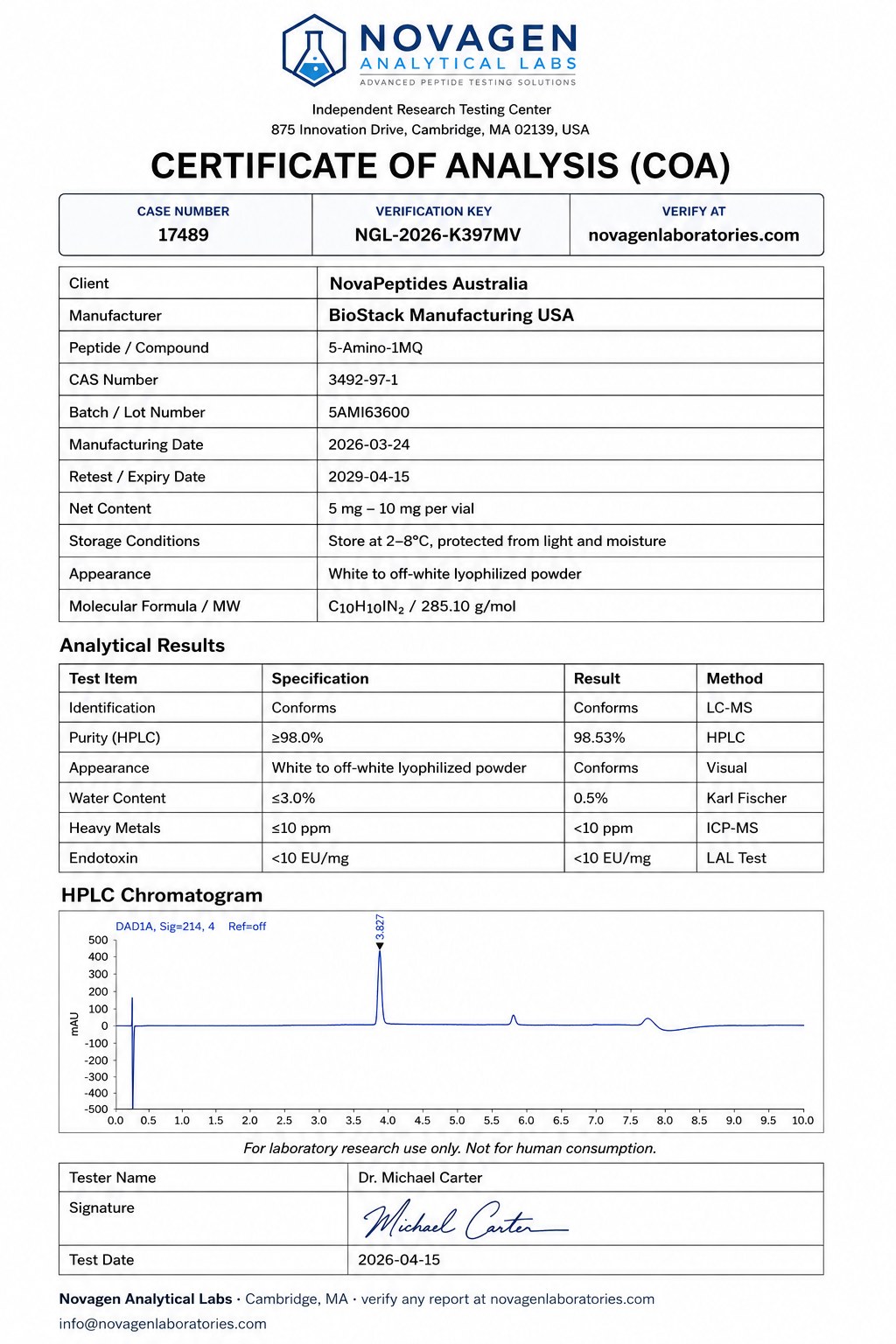
Verify any batch yourself
No smoke, no mirrors. Copy the unique key printed on the COA, enter it at Novagen Laboratories, and the certificate is confirmed as genuine. Ask us on WhatsApp and we will send the report for your current batch.
Verify at novagenlaboratories.com →How to research Retatrutide with NovaPeptides
At NovaPeptides, Retatrutide is supplied within the Retatrutide research kit as a complete, ready-to-assemble research kit rather than a loose vial, with the reusable dosing pen, bacteriostatic water, needle heads, an extraction syringe and a thermal hard case, plus a verifiable Novagen Laboratories Certificate of Analysis. Because the right concentration depends on how much bacteriostatic water you reconstitute with, we keep the click-by-click method on a U-100 pen in one place.
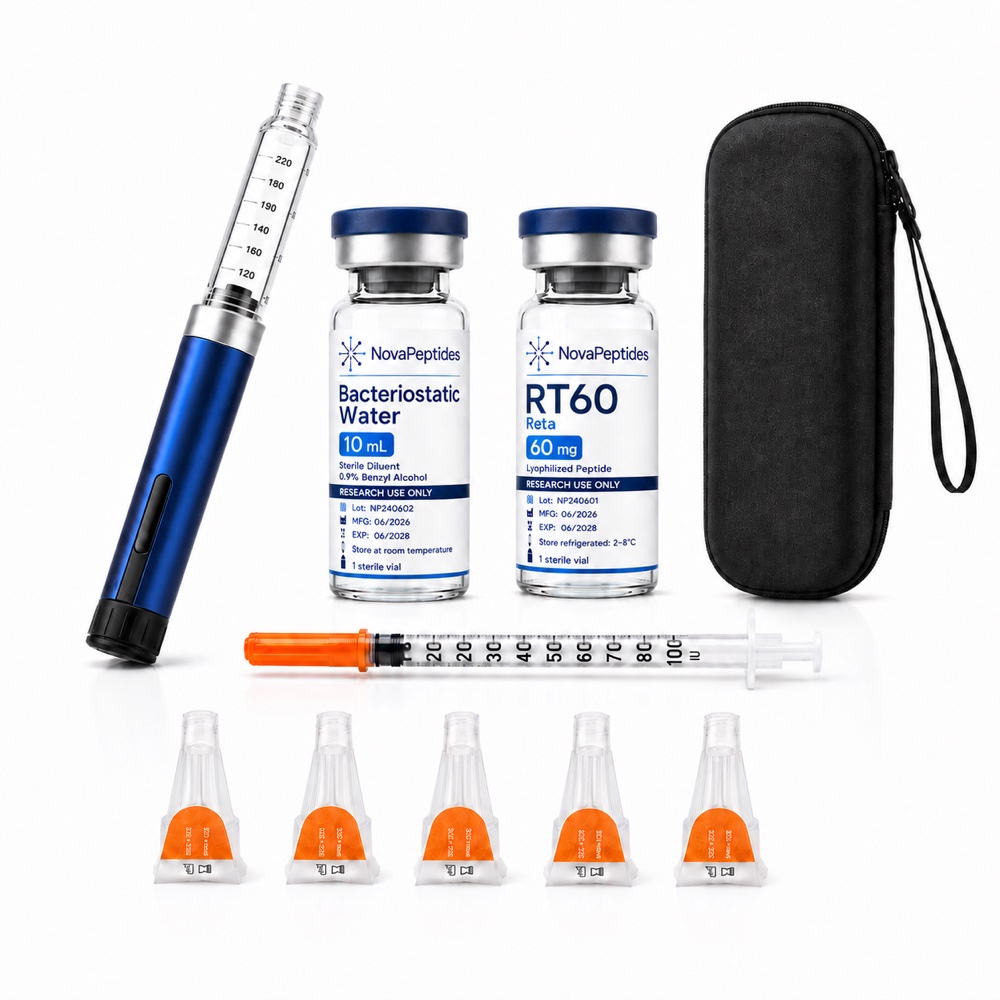
Retatrutide research kit
Contains Retatrutide, supplied as a complete, ready-to-assemble research kit. Research use only.
Enquire about RetatrutideNew to reconstitution? Our interactive pen and dosing guide shows how clicks convert to milligrams on a U-100 pen, with a switch for 2mL or 3mL of bacteriostatic water. It is provided for research reference only and is not a recommendation for human use. The dose you target is a decision for a qualified professional, not advice from us.
Frequently asked questions
What is retatrutide?+
Retatrutide (LY3437943, also called Reta or Triple G) is an investigational single-molecule peptide studied for its activity at three receptors: GLP-1, GIP and glucagon. Developed by Eli Lilly, it is one of the most studied triple-hormone-receptor agonists and is currently in phase-3 clinical trials. It is not approved by any regulator and is supplied by NovaPeptides for laboratory research use only. NovaPeptides is Australian-owned and has supplied research peptides to Australians for over 3 years, with a verifiable COA on every batch.
How does retatrutide differ from tirzepatide and semaglutide?+
The difference is the number of receptors engaged. Semaglutide is a single agonist targeting GLP-1 only. Tirzepatide is a dual agonist targeting GLP-1 and GIP. Retatrutide is a triple agonist studied for adding the glucagon receptor on top of both incretin pathways, giving it the full GLP-1 GIP glucagon profile. That glucagon arm is investigated for effects on energy expenditure in research models that dual and single agonists do not engage.
Why is retatrutide called Triple G?+
The nickname Triple G refers to its triple GPCR agonism, meaning it is studied for activating three G-protein-coupled receptors at once: GLP-1, GIP and glucagon. Researchers coined the shorthand because retatrutide is a leading example of a triple agonist, distinguishing it from dual agonists like tirzepatide and single agonists like semaglutide. It is also referred to by its development code LY3437943 and as Reta.
What did the retatrutide phase-2 trial show?+
The phase-2 trial, published in the New England Journal of Medicine in 2023, was a randomised placebo-controlled study in adults with obesity over 48 weeks. According to the published trial, the highest 12 mg dose was associated with a mean body-weight reduction of up to approximately 24% at 48 weeks, reported as dose-dependent. The most common adverse events were gastrointestinal and described in the trial as generally mild to moderate. This is reported retatrutide research data, not a claim of effectiveness for human use.
What is the TRIUMPH program?+
TRIUMPH is Eli Lilly's phase-3 clinical program for retatrutide, initiated after the phase-2 results. It is a multi-trial program investigating retatrutide across a range of doses and multiple metabolic endpoints. It represents the pivotal-stage research that any future regulatory submission would draw upon, and it is a major reason interest in retatrutide Australia wide keeps growing.
Is retatrutide approved in Australia?+
No. Retatrutide is not approved by the TGA or any other regulator worldwide. It remains an investigational compound in phase-3 clinical trials. There is no approved retatrutide product for human therapeutic use in Australia. NovaPeptides supplies it strictly as a research reference material for laboratory research use only.
Is it legal to buy retatrutide in Australia?+
Retatrutide cannot be lawfully supplied, advertised or sold for human therapeutic use in Australia because it is unapproved by the TGA. It can, however, be supplied as a research-use-only reference material for legitimate laboratory work. It is not a medicine or supplement and must never be used for human consumption or self-administration. The TGA has publicly cautioned about unapproved peptides, which is why sourcing from a transparent, Australian-owned supplier that independently lab-tests every batch and provides a verifiable COA matters. NovaPeptides has done exactly that for over 3 years.
What is the difference between RT10, RT20 and RT30?+
RT10, RT20 and RT30 are NovaPeptides kit designations indicating the total retatrutide content of the research kit, with RT30 being the highest strength. Each kit ships as a complete unit with a reusable dosing pen and a batch-specific Novagen Laboratories Certificate of Analysis. Researchers select the strength that suits their study; NovaPeptides supplies the verified material only, dispatched same-day from the Gold Coast with discreet tracked shipping.
How do I verify a NovaPeptides retatrutide COA?+
Every retatrutide batch is independently lab-tested and ships with a Novagen Laboratories Certificate of Analysis carrying a unique verification key. Enter that key at novagenlaboratories.com to confirm the retatrutide COA is genuine and matches your kit. This third-party verification documents identity and purity for the specific lot, which is what separates a properly documented research reference material from an unverified product. You can check it yourself, any time.
How do I buy retatrutide in Australia and enquire?+
NovaPeptides supplies retatrutide as complete RT10, RT20 or RT30 research kits, each with a reusable dosing pen and a verifiable Novagen Laboratories COA. NovaPeptides is a catalogue and education resource with no online cart or public pricing. To buy retatrutide Australia wide or ask a question, message the NovaPeptides team directly on WhatsApp and a real person will help. Orders are dispatched same-day from the Gold Coast with discreet tracked shipping. All material is supplied for research use only.
What peptides are studied alongside retatrutide?+
Retatrutide is most often compared with tirzepatide, its closest mechanistic neighbour as a dual GLP-1 GIP agonist, making it the natural reference for triple-versus-dual research. In separate recovery-focused research contexts, peptides such as BPC-157 and the GLOW blend (GHK-Cu, BPC-157 and TB-500) are also studied. Each is a distinct compound with its own published literature and is supplied for research use only, with the same verifiable COA standard NovaPeptides has held for over 3 years.
Researching Retatrutide?
Message us and we will walk you through Retatrutide, the COA, reconstitution and how the kit goes together.
Chat with us on WhatsApp