
What is GHK-Cu?
GHK-Cu is a copper-binding tripeptide made of three amino acids, glycine, L-histidine and L-lysine, holding a single copper(II) ion. Put simply, it is the copper tripeptide: one small peptide carrying one atom of copper. It occurs naturally in the human body and is one of the most studied peptides in skin and tissue research, which is exactly why GHK-Cu skin research draws so much attention. It is supplied strictly for laboratory and educational research.
GHK-Cu is supplied strictly for laboratory and educational research and is not TGA-approved for human consumption. Nothing on this page is medical advice or a treatment claim. Peptides referenced are investigational and not approved for human use.
What makes GHK-Cu unusual is that it is not a synthetic invention. It occurs naturally in human blood plasma, saliva and urine. It was first isolated by Dr Loren Pickart in 1973, who noticed that a fraction of human plasma could make aged liver tissue behave more like young tissue in the laboratory. The active fraction turned out to be GHK, the copper peptide researchers still study closely today.
How GHK-Cu is thought to work
The GHK copper peptide is best understood as a signalling and delivery molecule. Research points to a few overlapping mechanisms that are studied together rather than in isolation.
Mechanisms studied in the research
- Copper delivery: copper is a cofactor for enzymes involved in building and cross-linking collagen and elastin, the proteins that give skin its structure and bounce. GHK has a very high affinity for copper and shuttles it to where cells can use it.
- Stimulating the matrix: in laboratory studies GHK-Cu has been shown to stimulate the production of collagen, elastin and glycosaminoglycans, the cushioning molecules in skin, and to support the fibroblasts that manufacture them.
- Resetting gene expression: published gene-profiling research suggests GHK may shift the activity of many human genes toward a more youthful pattern in laboratory models, associated with repair pathways and with lower inflammatory and stress signalling.
- Antioxidant and anti-inflammatory activity: GHK-Cu has been studied for its ability to neutralise reactive oxygen species and to calm inflammatory signalling, both central to how tissue recovers from damage in research models.
The systems-level picture is what excites researchers most, because it goes beyond a single target. Imagery and illustrations used in our materials are for educational purposes only.
GHK-Cu and skin
Skin is where the copper peptide earned its reputation, and GHK-Cu skin research remains its most active field. Across the published literature, GHK-Cu has been studied for a cluster of related effects.
What the research has looked at
- Studied for its effect on collagen and elastin production and on skin firmness and elasticity
- The look of fine lines and skin thickness in ageing and photodamaged skin
- The skin barrier and overall skin density and tone
- The appearance of damage from sun exposure and oxidative stress
This is why the GHK copper peptide became a staple ingredient in serious cosmeceutical formulations long before the current peptide wave. The same properties studied for skin repair after injury are the ones associated in research with smoother, firmer, healthier looking skin over time. In a research context, GHK-Cu is studied both as a topical and as a reconstituted peptide.
GHK-Cu and hair
The copper peptide is also studied in hair research. GHK-Cu has been observed to enlarge hair follicles and extend the growth phase of the hair cycle in laboratory and animal models, and copper peptides have been investigated for their effect on follicle size and the appearance of thicker hair.
Because the same repair and matrix-building pathways are involved, hair is a natural extension of the skin research, and it is one of the reasons GHK-Cu shows up so often in peptide discussions. It remains an area of investigation, not a promised outcome.
Tissue repair and recovery
Beyond skin and hair, GHK-Cu has a long history in wound healing research. Studies have looked at its role in attracting repair cells to a site of injury, supporting the formation of new blood vessels (angiogenesis), and improving the quality of healed tissue in laboratory and animal models.
This regenerative angle is exactly why the copper peptide pairs so naturally with recovery peptides in a research blend, and it sets up the logic behind GLOW.
GHK-Cu in the GLOW blend
At NovaPeptides, GHK-Cu is the lead peptide in GLOW, our regenerative research blend. Rather than GHK-Cu on its own, GLOW combines three peptides that are each studied for skin, recovery and tissue repair, so the research story is broader than any single one.
What is in GLOW
- GLOW total: a 70mg regenerative peptide blend
- GHK-Cu: the copper peptide, studied for skin, collagen and repair
- BPC-157: a body-protection peptide studied for tissue and gut repair in research models
- TB-500: a thymosin fragment studied for recovery and flexibility in research models
The idea behind a blend is a shared research story: GHK-Cu brings the copper-driven skin and collagen research, while BPC-157 and TB-500 add their own well-studied recovery and repair profiles. Together they make GLOW one of the most complete regenerative research kits we offer. NovaPeptides has been supplying research peptides to Australians for over 3 years, so researchers ordering GLOW are in experienced hands. Researchers can enquire about GLOW via WhatsApp; supplied for research use only.
Research handling and reconstitution
GHK-Cu and the GLOW blend ship as a lyophilised (freeze-dried) powder. In a research setting it is reconstituted with bacteriostatic water before use. For GLOW, reconstituting the 70mg blend with 3mL of bacteriostatic water gives a working concentration where each 0.01mL click on a U-100 pen corresponds to about 0.23mg of the blend. These figures describe the laboratory preparation only, never a dose for a person.
We keep the complete calculations, including how the 70mg GLOW blend converts to clicks on a U-100 pen, on our interactive pen and dosing guide. It is provided for research reference only and is not a recommendation for human use.
Purity, testing and buying GHK-Cu in Australia
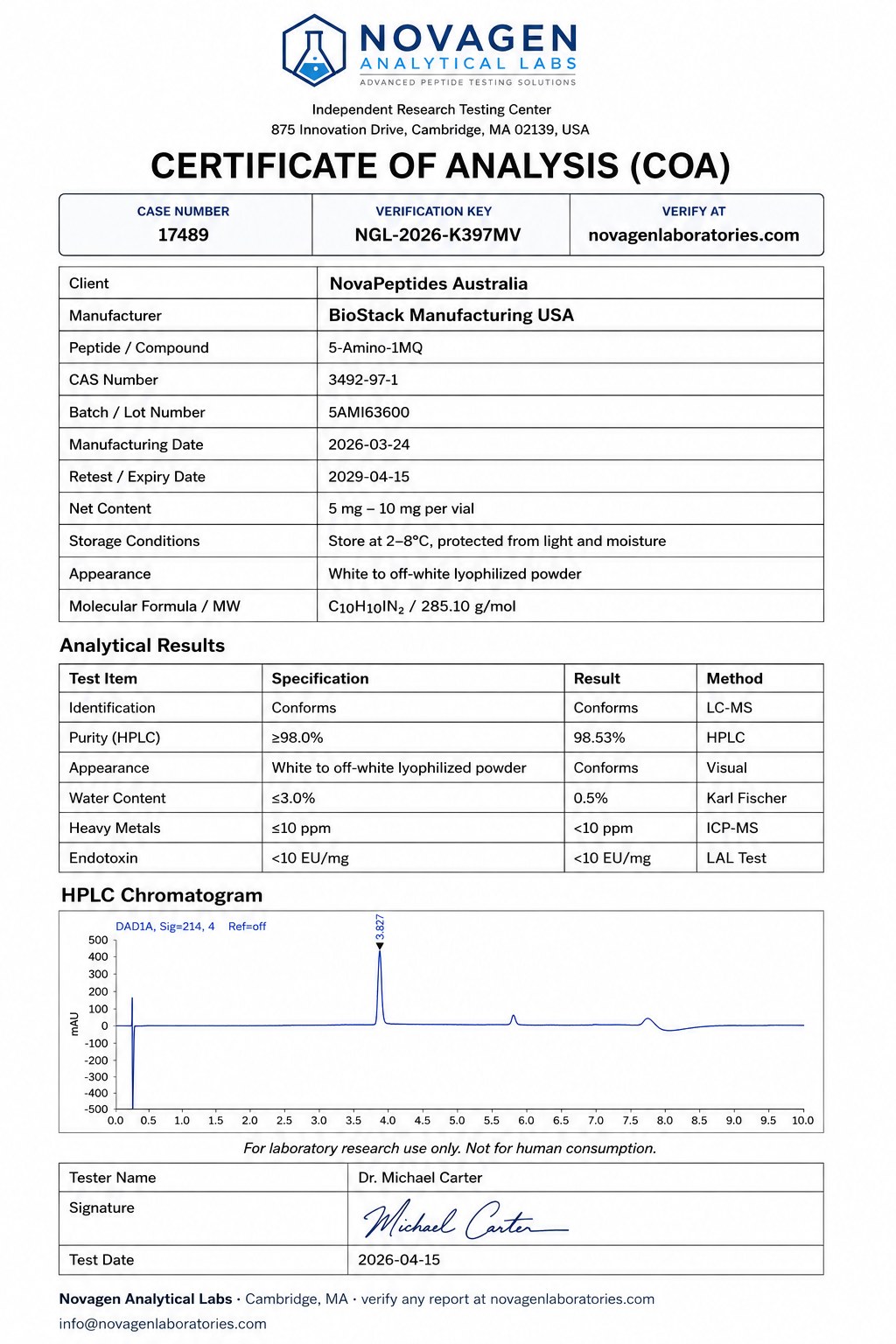
With copper peptides, quality is everything, because identity and purity determine whether research is meaningful. Every NovaPeptides batch, including the GHK-Cu in GLOW, is independently lab-tested by Novagen Laboratories and ships with a verifiable GHK-Cu COA that confirms purity, content and identity. Each Certificate of Analysis carries a unique key you can check yourself, so nothing is taken on trust.
No smoke, no mirrors. Each batch is independently verified for purity, content and identity, and you can check the Certificate of Analysis yourself with its unique key.
This lab-proof transparency, rather than any named expert or treatment claim, is how we stand behind the catalogue. If you want to buy GHK-Cu in Australia for research, NovaPeptides is Australian owned, dispatches same-day from the Gold Coast and ships discreet, tracked orders of research peptides Australia-wide, backed by real support and a 3-year track record. Content is prepared by the NovaPeptides Research Team using research and education references.
Verified by Novagen Laboratories
Every NovaPeptides batch, including the GHK-Cu in the GLOW blend, ships with a verifiable Novagen Laboratories Certificate of Analysis covering identity, content and purity. Each certificate carries a unique key so you can confirm it is genuine yourself.
Verify any batch yourself
No smoke, no mirrors. Copy the unique key printed on the COA, enter it at Novagen Laboratories, and the certificate is confirmed as genuine. Ask us on WhatsApp and we will send the report for your current batch.
Verify at novagenlaboratories.com →How to research GHK-Cu with NovaPeptides
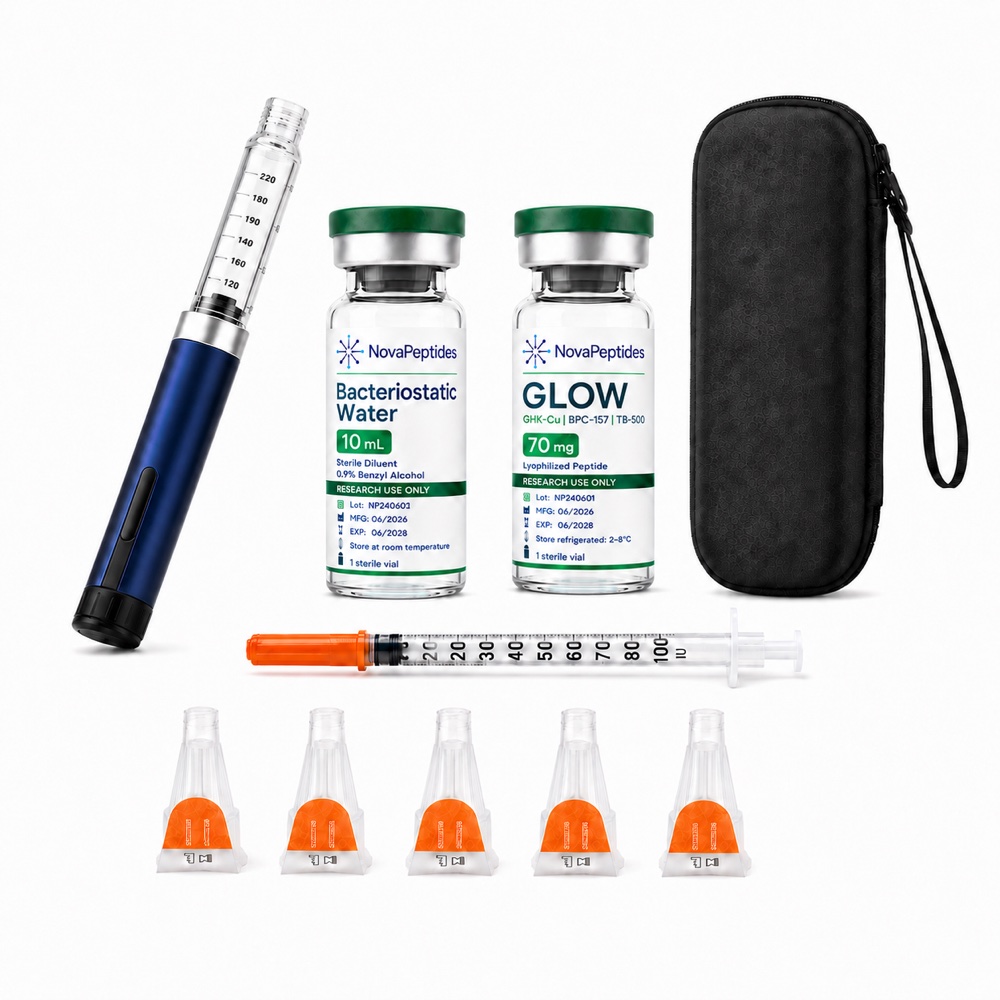
At NovaPeptides, GHK-Cu is supplied within the GLOW blend as a complete, ready-to-assemble research kit rather than a loose vial, with the reusable dosing pen, bacteriostatic water, needle heads, an extraction syringe and a thermal hard case, plus a verifiable Novagen Laboratories Certificate of Analysis. Because the right concentration depends on how much bacteriostatic water you reconstitute with, we keep the click-by-click method on a U-100 pen in one place.
GLOW blend
Contains GHK-Cu, supplied as a complete, ready-to-assemble research kit. Research use only.
Enquire about GHK-CuNew to reconstitution? Our interactive pen and dosing guide shows how clicks convert to milligrams on a U-100 pen, with a switch for 2mL or 3mL of bacteriostatic water. It is provided for research reference only and is not a recommendation for human use. The dose you target is a decision for a qualified professional, not advice from us.
Frequently asked questions
What is GHK-Cu?+
GHK-Cu is a copper-binding tripeptide made of glycine, histidine and lysine bound to a copper ion, which is why it is often called the GHK copper peptide. It occurs naturally in human plasma and is one of the most studied peptides in skin and tissue repair research. Supplied for laboratory and research use only, not TGA-approved for human consumption.
What is GHK-Cu studied for?+
In published research the copper peptide has been studied for collagen and elastin production, skin firmness and elasticity, wound healing, hair follicle support, antioxidant activity and anti-inflammatory signalling. GHK-Cu skin research is its best-known field. It is for laboratory and educational research only and is not a treatment.
Is GHK-Cu the same as the GLOW peptide?+
GHK-Cu is the primary peptide in NovaPeptides GLOW. GLOW is a 70mg regenerative blend that pairs GHK-Cu with BPC-157 and TB-500, three peptides studied together for skin, recovery and tissue repair in research models.
How is GHK-Cu reconstituted?+
In a research setting, the freeze-dried peptide is reconstituted with bacteriostatic water. The GLOW 70mg blend reconstituted with 3mL corresponds to about 0.23mg of blend per 0.01mL click on a U-100 pen. See our pen and dosing guide for the full maths. This describes the laboratory preparation only, research use only.
Can I buy GHK-Cu in Australia?+
Yes. NovaPeptides supplies GHK-Cu within the GLOW research kit and has been supplying research peptides to Australians for over 3 years. We are Australian owned, dispatch same-day from the Gold Coast and ship discreet tracked orders Australia-wide, with a verifiable GHK-Cu COA from Novagen Laboratories on every batch. It is supplied strictly for laboratory and research use and is not TGA-approved for human consumption.
Researching GHK-Cu?
Message us and we will walk you through GHK-Cu, the COA, reconstitution and how the kit goes together.
Chat with us on WhatsApp