
What is BPC-157?
BPC-157 (Body Protection Compound 157), also referenced in the literature as PL 14736, is a synthetic pentadecapeptide: a chain of 15 amino acids with the sequence Gly-Glu-Pro-Pro-Pro-Gly-Lys-Pro-Ala-Asp-Asp-Ala-Gly-Leu-Val. It is described in the research as a stable fragment related to a larger body protection compound isolated from human gastric juice. Because it is associated with the highly acidic environment of the stomach, BPC-157 is reported to be resistant to hydrolysis and enzymatic digestion in the models studied, a property that researchers have highlighted as distinguishing it from many other research peptides. That combination of a well characterised sequence and reported stability is a large part of why BPC-157 research is so widely referenced.
In preclinical research, BPC-157 has been studied for its reported effects on soft tissue repair (tendon, ligament and muscle), gastrointestinal healing, bone repair, neuroprotection and vascular repair. The majority of this evidence comes from animal and in vitro models. Only a small number of human studies have been published, and these are not large randomised controlled trials. BPC-157 is a research compound, not an approved therapeutic, and everything below is presented in that research context so you can read it with clear eyes. When Australians search for BPC-157 repair research, this is the honest picture: a broad and interesting preclinical base, described carefully rather than overpromised.
BPC-157 is supplied strictly for laboratory and research use. It is not a medicine, not a supplement, and not for human or animal consumption. Nothing here is medical advice or a dosing protocol. We would rather earn your trust with an accurate description than an exaggerated one.
How BPC-157 is studied: proposed mechanism of action
The central mechanism attributed to BPC-157 in the research is the modulation of angiogenesis, the formation of new blood vessels. In animal models of muscle and tendon injury, BPC-157 has been reported to up-regulate vascular endothelial growth factor (VEGF) and to interact with the VEGFR2 receptor and the nitric oxide pathway via the Akt-eNOS axis. Researchers propose that improved vascularisation may deliver more oxygen and nutrients to a damaged site, which they link to the tissue repair observed in these models. This angiogenic angle is the thread that runs through most BPC-157 research.
A second reported mechanism is the up-regulation of the growth hormone receptor in tendon fibroblasts. In vitro studies have reported that BPC-157 increases growth hormone receptor expression at both the mRNA and protein level in a dose and time dependent manner, alongside increased fibroblast survival under oxidative (H2O2) stress and increased cell migration. Together these actions are proposed to support the outgrowth and repair of connective tissue in the models studied.
Mechanisms reported in the research
- Angiogenesis: reported up-regulation of VEGF and signalling through VEGFR2 and the Akt-eNOS nitric oxide pathway
- Growth hormone receptor expression: reported increase in tendon fibroblasts, proposed to support collagen synthesis and cell proliferation
- Fibroblast activity: reported survival under oxidative stress and dose dependent cell migration
- Neurotransmitter interaction: reported modulation of dopamine, serotonin, GABA and nitric oxide systems in rodent models
- Cytoprotection: reported reduction in oxidative stress and protection of gastrointestinal and other tissue in injury models
The body of research: soft tissue, gut and gut-brain axis
BPC-157 has one of the broadest preclinical footprints of any research peptide, spanning three main areas of investigation. That breadth is exactly why it is the single most searched recovery and repair research peptide among Australian researchers.
Soft tissue and musculoskeletal repair is the most studied area, and it is the reason most people first look into BPC-157 repair research. Rodent models have investigated BPC-157 for reported acceleration of healing in transected tendons, ligaments, muscle and bone, with faster functional recovery attributed to the angiogenic and growth hormone receptor mechanisms above. Narrative reviews in the musculoskeletal literature describe these results as broadly consistent across models while emphasising that human evidence remains limited. This is where the tendon, joint, shoulder and knee search interest tends to originate.
Gastrointestinal repair reflects the peptide's reported origin. Because BPC-157 is described as a fragment related to a gastric juice protein and is reported to be stable in gastric acid, it has been extensively studied for protective and healing effects on the gut lining in animal models, including models of ulcers and inflammatory injury. It is proposed to support intestinal healing by stimulating local angiogenesis, up-regulating growth hormone receptors in gut tissue, and reducing oxidative stress in these models.
The gut-brain axis is a more recent line of enquiry. The gut produces a large share of the body's serotonin and dopamine, and the gut and brain are known to communicate bidirectionally. Rodent research has explored BPC-157 for its reported modulation of serotonin and dopamine systems, describing anxiolytic-like and antidepressant-like behaviour in these models, alongside its reported gut-healing effects. Reviews frame this as a proposed dual action: supporting the gut lining while also acting on neural tissue. This remains early, preclinical and behavioural, not clinical.
In experimental models of muscle, tendon, ligament, bone and gastrointestinal tissue, BPC-157 has been studied for its reported effects on angiogenesis, collagen synthesis, fibroblast activity and modulation of nitric oxide pathways.
Why BPC-157 is paired with TB-500 (the Wolverine Stack)
BPC-157 is frequently studied and discussed alongside TB-500 (a synthetic fragment of thymosin beta-4), a combination researchers and communities have nicknamed the "Wolverine Stack" for its focus on tissue recovery research. The BPC 157 TB 500 Wolverine stack is one of the most requested pairings among Australian researchers, and the rationale is complementary mechanisms rather than overlap.
In the models studied, BPC-157 is reported to act largely locally at the site of injury, associated with angiogenesis and blood flow to the damaged area. TB-500 is described as acting more systemically, associated with the mobility and migration of repair cells across tissues via its influence on actin regulation. The proposed picture is that BPC-157 may support blood supply to an injured region while TB-500 may help repair cells reach and populate it. It is worth being clear that the combination itself has not been clinically validated; the proposed synergy is inferred from the individual peptides' preclinical profiles, and we present it that way rather than dressing it up.
This pairing is why BPC-157 appears in blended research kits. NovaPeptides supplies BPC-157 within the Wolverine kit (with TB-500), the GLOW kit (GHK-Cu, BPC-157, TB-500) and the KLOW kit (GHK-Cu, BPC-157, TB-500 and KPV), each formulated as a complete blend rather than a loose single vial, for research use only. As with every product in our range, each of these kits is backed by a verifiable Novagen Laboratories Certificate of Analysis.
BPC-157 vs TB-500 at a glance
| Attribute | BPC-157 | TB-500 |
|---|---|---|
| Class | Pentadecapeptide (15 aa) | Thymosin beta-4 fragment |
| Reported action in research | Local angiogenesis and blood flow | Systemic cell migration and mobility |
| Origin | Gastric juice protein fragment | Thymosin beta-4 protein |
| Oral research context | Reported acid-stable; oral routes studied | Poor oral bioavailability; injectable in research |
| Researched for | Tendon, ligament, muscle, gut repair | Broad soft tissue and wound repair |
| Role in the stack | Studied at the injury site | Studied for moving repair cells to the site |
Oral vs injectable BPC-157 in the research
BPC-157 is unusual among research peptides because it has been studied via both oral and injectable routes. Its reported origin as a gastric juice fragment is associated with stability in gastric acid, so oral administration is not automatically degraded the way most peptides are. In published animal studies, oral administration reportedly produced comparable gastrointestinal effects to injection, though typically at higher equivalent doses in those models. This dual-route research base is one reason BPC-157 stands out in the wider research peptides Australia conversation.
The research context generally distinguishes the two routes by target tissue. Oral routes make direct mucosal contact and have been used in gastrointestinal models, while injectable routes deliver more of the peptide systemically and feature in musculoskeletal injury models. By contrast, its common partner TB-500 does not survive the gut and is studied by injection only, which is one reason blended kits are formulated for reconstitution rather than oral use.
Route-of-administration findings are reported here as research context only. NovaPeptides does not provide dosing protocols, and none of this constitutes instructions for use.
Stability and handling in the lab
BPC-157 is noted in research settings for its reported stability. The intact peptide is described as resistant to hydrolysis and enzymatic digestion, associated with its gastric juice origin, making it comparatively robust next to more fragile research peptides. Once a lyophilised (freeze-dried) peptide is reconstituted with bacteriostatic water, however, it behaves like any peptide in solution: potency degrades over time, and it should be kept refrigerated and handled carefully to preserve integrity for the research window. Starting from a batch of confirmed identity and purity, which is what the Novagen COA on every NovaPeptides batch is there to establish, gives that handling window a reliable foundation.
General laboratory handling principles
- Store lyophilised peptide cool and dry, away from light and moisture, until reconstitution
- Reconstitute with bacteriostatic water using aseptic technique
- Refrigerate the reconstituted solution and use it within its stable window
- Avoid repeated freeze-thaw cycles and unnecessary agitation
- Verify batch identity and purity against the supplied Certificate of Analysis
BPC-157 legal status in Australia (Schedule 4)
In Australia, BPC-157 is a Schedule 4 (Prescription Only) substance under the national poisons framework. In practical terms this means BPC-157 sits alongside other prescription-only medicines and is not a general-sale supplement, regardless of how it is marketed online. We would rather tell you that plainly than gloss over it, because knowing exactly what you are dealing with is part of being in safe hands.
Legitimate research use remains recognised: BPC-157 is available for genuine laboratory and research purposes, and the TGA permits use within approved clinical trials that carry ethics committee approval and are registered on the Australian New Zealand Clinical Trials Registry (ANZCTR). NovaPeptides supplies BPC-157 strictly on a research-use-only basis. It is not sold or supplied for human or animal consumption, and buyers are responsible for handling it in accordance with the law. What we can give you with confidence is transparency: an Australian-owned supplier with a track record of over 3 years, a verifiable third-party Certificate of Analysis on every batch, and discreet tracked dispatch, so the parts we can stand behind are backed by proof rather than promises.
BPC-157 is a Schedule 4 substance in Australia. NovaPeptides is a research-catalogue and education resource. We do not provide medical advice, we do not supply for personal use, and we make no claims that BPC-157 treats, cures or is safe for any human condition.
How NovaPeptides supplies BPC-157: kits, pen and Novagen COA
If you have been searching for where to buy BPC-157 in Australia from a supplier you can actually trust, this is where NovaPeptides earns it. NovaPeptides has been supplying research peptides to Australians for over 3 years, is Australian-owned, and dispatches same-day from the Gold Coast with discreet tracked shipping Australia-wide. We supply BPC-157 as part of complete research kits, not as a loose vial, which matters for researchers who want a consistent, ready-to-use setup. Each kit arrives with everything needed to reconstitute and measure, including a reusable dosing pen, so the research workflow is standardised rather than improvised with long syringes and manual drawing.
Kits that contain BPC-157
- Wolverine kit: BPC-157 paired with TB-500, the classic recovery-focused research stack
- GLOW kit: GHK-Cu, BPC-157 and TB-500, a skin, hair and recovery research blend
- KLOW kit: GHK-Cu, BPC-157, TB-500 and KPV, a broader recovery and repair research blend
Every batch is independently verified by Novagen Laboratories, which issues a Certificate of Analysis (COA) confirming identity and purity. Each COA carries a unique verification key that you can check yourself at novagenlaboratories.com, so the lab result is transparent rather than a claim you have to take on faith. Buying BPC-157 with a COA you can verify yourself is exactly the reassurance most Australian researchers are looking for, and that verifiable-proof approach is central to how NovaPeptides operates: proof, not promises.
NovaPeptides is a catalogue and education resource with no cart or pricing on-site. To ask about the Wolverine, GLOW or KLOW research kits, or to request a batch COA, start a WhatsApp enquiry and our team will help. All supply is strictly research use only.
Verified by Novagen Laboratories
Every NovaPeptides batch, including the BPC-157 in the Wolverine Stack, ships with a verifiable Novagen Laboratories Certificate of Analysis covering identity, content and purity. Each certificate carries a unique key so you can confirm it is genuine yourself.
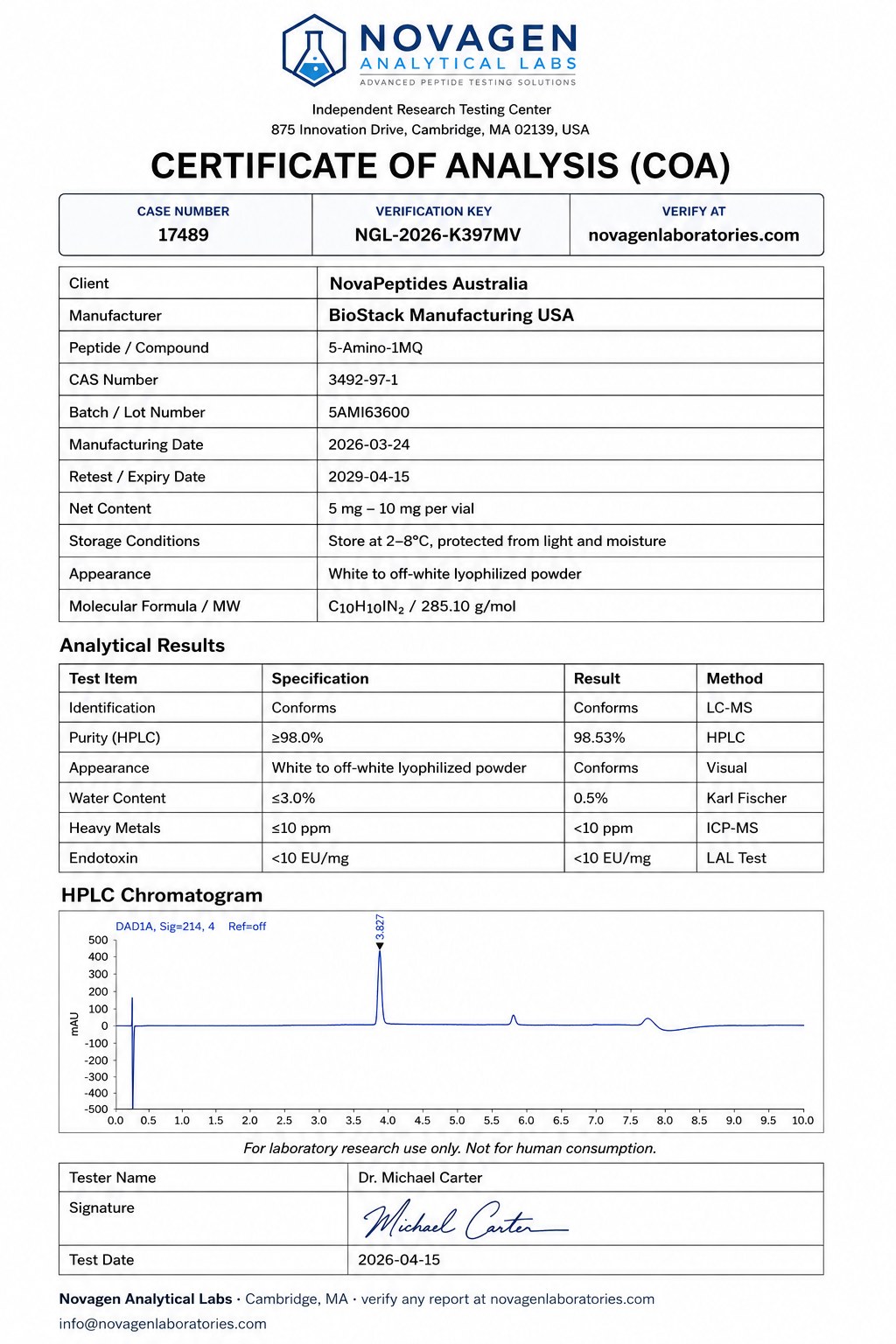
Verify any batch yourself
No smoke, no mirrors. Copy the unique key printed on the COA, enter it at Novagen Laboratories, and the certificate is confirmed as genuine. Ask us on WhatsApp and we will send the report for your current batch.
Verify at novagenlaboratories.com →How to research BPC-157 with NovaPeptides
At NovaPeptides, BPC-157 is supplied within the Wolverine Stack as a complete, ready-to-assemble research kit rather than a loose vial, with the reusable dosing pen, bacteriostatic water, needle heads, an extraction syringe and a thermal hard case, plus a verifiable Novagen Laboratories Certificate of Analysis. Because the right concentration depends on how much bacteriostatic water you reconstitute with, we keep the click-by-click method on a U-100 pen in one place.
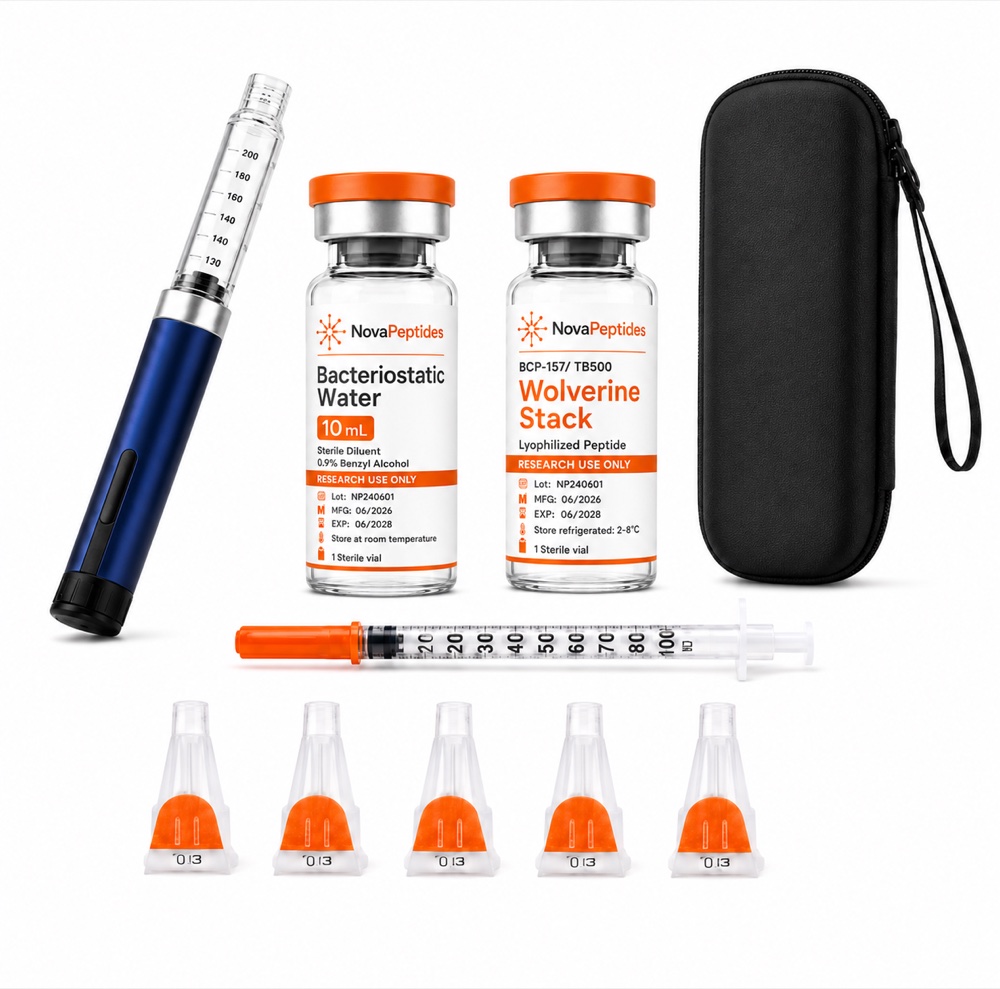
Wolverine Stack
Contains BPC-157, supplied as a complete, ready-to-assemble research kit. Research use only.
Enquire about BPC-157New to reconstitution? Our interactive pen and dosing guide shows how clicks convert to milligrams on a U-100 pen, with a switch for 2mL or 3mL of bacteriostatic water. It is provided for research reference only and is not a recommendation for human use. The dose you target is a decision for a qualified professional, not advice from us.
Frequently asked questions
What is BPC-157?+
BPC-157 (Body Protection Compound 157, also called PL 14736) is a synthetic pentadecapeptide, a chain of 15 amino acids related to a protective protein found in gastric juice. In animal and laboratory research it is studied for tendon, ligament, muscle and gastrointestinal tissue repair research and for angiogenesis. It is a research compound supplied for laboratory use only, not an approved medicine or supplement.
What is BPC-157 researched for?+
In preclinical models, BPC-157 is researched for soft tissue repair (tendon, ligament and muscle), gastrointestinal healing, bone repair, neuroprotection and vascular repair, which is why so much BPC-157 repair research centres on tendon, joint, shoulder and knee models. Its most documented reported mechanism is the promotion of angiogenesis via up-regulation of VEGF. Nearly all of this evidence comes from animal and in vitro studies. Human data is limited, and BPC-157 is not proven to treat, cure or heal any condition in people.
How is BPC-157 studied to work?+
In the research, BPC-157 is proposed to work primarily by modulating angiogenesis, the formation of new blood vessels, through reported up-regulation of VEGF and signalling via VEGFR2 and the nitric oxide (Akt-eNOS) pathway. It is also reported to increase growth hormone receptor expression in tendon fibroblasts and to support fibroblast survival and migration. Researchers link improved blood supply and connective tissue cell activity to the tissue repair seen in animal models. This is research context, not a clinical claim.
Can I buy BPC-157 in Australia, and is it legal?+
BPC-157 is a Schedule 4 (Prescription Only) substance in Australia and is not a general-sale supplement. Genuine laboratory and research use is recognised, and the TGA permits its use in approved, registered clinical trials. NovaPeptides supplies BPC-157 in Australia strictly for research use only, never for human or animal consumption. What we can offer with confidence is a transparent, Australian-owned supplier with a track record of over 3 years and a verifiable Novagen Certificate of Analysis on every batch.
What is the Wolverine Stack (BPC-157 and TB-500)?+
The BPC 157 TB 500 Wolverine stack refers to combining BPC-157 with TB-500, a thymosin beta-4 fragment, for tissue recovery research. The rationale is complementary reported mechanisms: BPC-157 is studied for local action at an injury site associated with blood flow and angiogenesis, while TB-500 is studied for more systemic action associated with helping repair cells migrate to the area. The combination itself has not been clinically validated; the proposed synergy is inferred from each peptide's preclinical profile.
Has BPC-157 been studied orally?+
Uniquely among research peptides, BPC-157 has been studied by both oral and injectable routes because it is reported to be stable in gastric acid, reflecting its origin as a gastric juice fragment. In animal studies, oral administration reportedly produced comparable gastrointestinal effects to injection, typically at higher equivalent doses. Oral routes feature in gut research; injectable routes feature in musculoskeletal research. This is research context only, not a protocol or instruction for use.
Is BPC-157 stable?+
The intact BPC-157 peptide is reported to be notably stable and resistant to hydrolysis and enzymatic digestion, associated with its gastric juice origin. Once a freeze-dried peptide is reconstituted with bacteriostatic water, however, it behaves like any peptide in solution: potency declines over time, so it should be refrigerated, protected from repeated freeze-thaw cycles, and used within its stable research window. Starting from a batch of verified identity and purity, confirmed by the Novagen COA, gives that window a dependable foundation.
What is the difference between BPC-157 and TB-500?+
BPC-157 is a 15 amino acid pentadecapeptide related to a gastric juice protein and is researched for local tissue repair via reported angiogenesis. TB-500 is a fragment of thymosin beta-4 researched for systemic cell migration and mobility. In recovery research they are considered complementary: BPC-157 is studied at the injury site while TB-500 is studied for helping move repair cells there, which is why they are often studied together as the Wolverine stack.
How does NovaPeptides supply BPC-157?+
NovaPeptides supplies BPC-157 as part of complete research kits, not loose vials. It appears in the Wolverine kit (with TB-500), the GLOW kit (GHK-Cu, BPC-157, TB-500) and the KLOW kit (GHK-Cu, BPC-157, TB-500, KPV). Each kit includes a reusable dosing pen, and every batch carries a Novagen Laboratories Certificate of Analysis with a unique verification key you can check at novagenlaboratories.com. NovaPeptides is Australian-owned, has supplied research peptides to Australians for over 3 years, and dispatches same-day from the Gold Coast with discreet tracked shipping. All supply is research use only.
How do I verify the BPC-157 Certificate of Analysis?+
Every NovaPeptides batch containing BPC-157 is independently tested by Novagen Laboratories, which issues a Certificate of Analysis confirming identity and purity. Each COA carries a unique verification key. You can enter that key at novagenlaboratories.com to confirm the result yourself, so the lab data is transparent and verifiable rather than a claim you simply have to trust. Being able to buy BPC-157 with a COA you check yourself is one of the clearest signals that you are dealing with a supplier that shows its work.
Does NovaPeptides sell BPC-157 online with prices?+
No. NovaPeptides is a research catalogue and education resource with no cart or pricing displayed on the site. To ask about the Wolverine, GLOW or KLOW research kits that contain BPC-157, or to request a batch Certificate of Analysis, you start a WhatsApp enquiry and the team assists you directly. All supply is strictly research use only.
Researching BPC-157?
Message us and we will walk you through BPC-157, the COA, reconstitution and how the kit goes together.
Chat with us on WhatsApp